
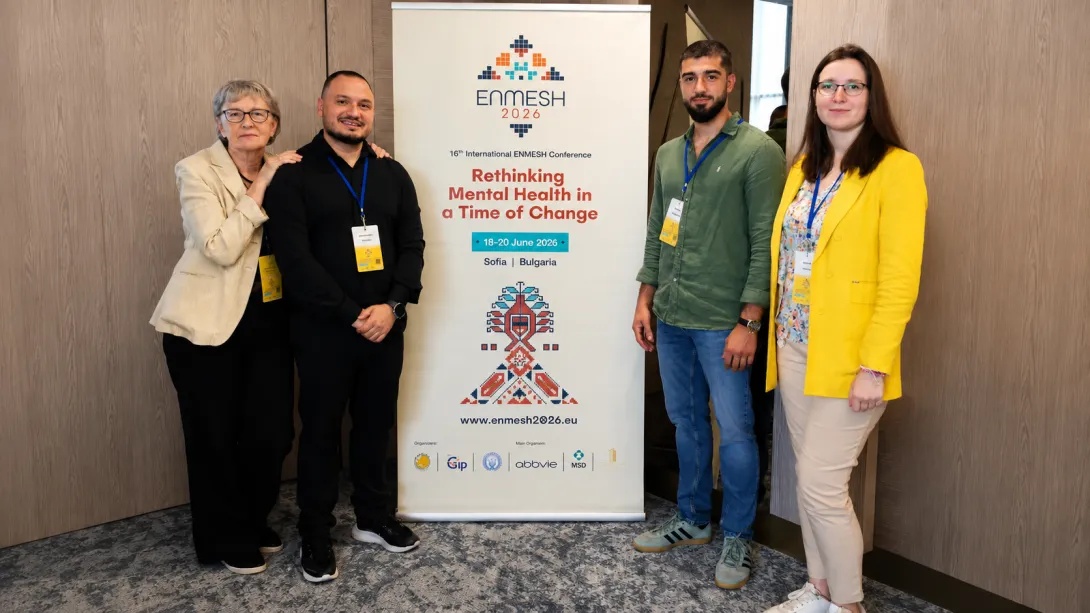
The Institute of Medical Psychology, Psycho-Oncology and Psychosomatics was presented at the 16th International Conference of the European Network for Mental Health Service Evaluation (ENMESH 2026) – one of the significant European scientific forums dedicated to the development, quality and future of mental health services. The conference brought together more than 500 scientists, physicians, psychiatrists, psychologists, social workers, health managers, and representatives of universities, healthcare institutions and international organisations from dozens of countries. ENMESH is an established European scientific network with more than three decades of history in developing research, policies and practices in the field of mental health. This year's edition took place under the motto “The Future of Mental Health Services Research” and focused on topics such as the development of community-based services, digital health and artificial intelligence, human rights, the reduction of stigma, integrated models of care, recovery after mental disorders, the evaluation of healthcare service quality, and the role of scientific evidence in shaping health policies. A particular focus of the discussions was the integration of mental health care into other medical specialties. There is growing recognition that quality care for people with chronic and severe illnesses, including oncological diseases, cannot be limited solely to medical diagnosis and treatment. The psychological, social and family consequences of illness are an essential part of the patient's experience and require a professional response.
Bulgarian data on the psychosocial needs of people with cancer
Within the framework of the conference, Aleksandar Milanov of the Institute of Medical Psychology, Psycho-Oncology and Psychosomatics presented a scientific poster dedicated to the psychosocial needs of people with oncological diseases and the role of clinical social work in addressing them. The study is based on clinical experience and an analysis of 185 oncological patients who received psychosocial support at the Centre for Clinical Psychology, Psycho-Oncology and Psychosomatics at Acibadem City Clinic UMBAL Tokuda. The data show that, beyond the medical diagnosis and treatment, patients often face anxiety, fear of progression or recurrence, uncertainty about the future, difficulties in communicating with the family, changes in working capacity, and the need to navigate the healthcare and social system. The analysis highlights the importance of psychosocial support at key moments along the oncological journey – at the time of diagnosis, during active treatment, at the transition to follow-up, in advanced disease, and when palliative care is required. During these periods, patients and their loved ones need not only medical information but also professional support in coping with emotional strain, making decisions, preserving social and family roles, and maintaining a sense of control over their own lives.
Clinical social work as part of comprehensive oncological care
The results presented highlight the role of clinical social work as part of the multidisciplinary care for people with oncological diseases. The clinical social worker helps identify psychosocial needs, supports the connection between the patient, the family and the medical team, assists with navigating the healthcare and social system, and facilitates access to resources and services. Their work is also aimed at adaptation to the illness and the changes it brings to daily life, professional life and family relationships. This approach views the patient not merely as the bearer of a diagnosis, but as a person whose illness occurs within a specific life, family and social context.
Psycho-oncology as part of contemporary care for people with cancer
The presentation of the study at ENMESH holds particular value for the development of the Institute's scientific and clinical work. The forum is a space for exchanging scientific evidence and good practices for the future of mental health services in Europe. The presence of topics such as psycho-oncology, integrated care and the psychosocial needs of people with severe illnesses reflects the growing importance of these areas in contemporary models of healthcare. For the Institute of Medical Psychology, Psycho-Oncology and Psychosomatics, participation in ENMESH 2026 is part of a broader commitment – to translate clinical experience into scientific knowledge, and scientific knowledge into better models of care for patients and their families. The Institute cultivates precisely this connection between clinical practice, scientific research, training and advocacy for the integration of psychological and social support into the care of people with severe and chronic illnesses. Participation in international scientific forums provides an opportunity for Bulgarian clinical experience and data to become part of the European professional dialogue, while at the same time allowing international standards and good practices to be brought to and developed further in Bulgaria.